
Kevin Warsh asked the Fed to stop setting policy on stale data. Here is what that costs, measured.

Note from Stefan Rust, Founder & CEO of Truflation
In his first Jackson Hole address as Chairman, Kevin Warsh gave a speech that reads less like a rate signal and more like a data mandate. He refused forward guidance. He refused a mechanical reaction function and he opened with a standard rather than a forecast: "We must interrogate reality to make sure we are not setting forward-looking policy based on stale or inaccurate data… the data upon which we draw must be as relevant, contemporaneous, accurate, and actionable as possible."
I have spent four years building a company around that sentence. So let me take it literally, and put numbers on the gap he is describing.
The measurement gap is the story
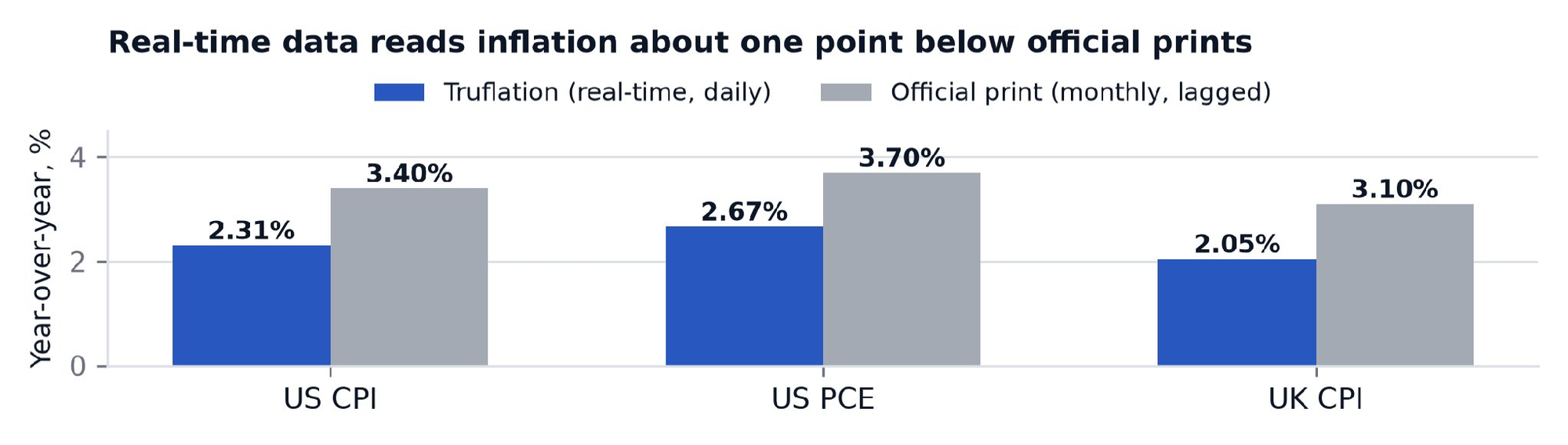
Warsh told the room that PCE inflation is running at 3.7% over twelve months and 4.1% over six, that this summer's better prints did not change the underlying trend and that if inflation is not moving to target clearly and at sufficient speed, the Fed has work to do.
Our real-time indexes tell a different story about the present. Truflation's US CPI reads 2.31% and our real-time PCE 2.67%, against official prints of 3.40% and 3.70%. The gap of roughly one point repeats in the UK, where we read 2.05% against 3.10% official.
The official numbers are not wrong.
They are old.We can say that with a straight face because the record is measurable. Our T-1 CPI forecasts runs at 99.93% accuracy against official BLS prints with real-time data that lands on the official number weeks before the official number exists. The architecture behind it is deliberately unglamorous: more than 100 million price points a day, over 500 indexes and feeds, 60-plus independent providers cross-checked against each other so no single source can move a print, with anomalies caught by disagreement between providers rather than by revision. Our PCE series is mapped to the BEA classification framework and its category weights. The comparison is like-for-like rather than a competing definition and the indexes are already where institutions work: US headline inflation and PCE are distributed through the Bloomberg Terminal, with more than 80 companies using our data globally.
This is not the first time official numbers are 'old.'
In December 1996 the Advisory Commission to Study the Consumer Price Index, appointed by the Senate Finance Committee and chaired by Michael Boskin, reported that the CPI overstated the true cost of living by about 1.1 percentage points a year, a finding that would have reduced projected Social Security outlays by roughly a trillion dollars. That error was a fiscal decision.
Two things to be clear about. Boskin said the ruler was mismarked: the way the CPI was built mismeasured inflation itself, and fixing it took a decade of committee work. We are saying something different; the number is right about a period that is over. Different problems, different fixes, and both landing near one percentage point is coincidence. What carries over is the precedent. Official price measurement has been shown to contain real, measured error, and saying so is a mainstream position.
The Taylor rule does not break. Its inputs do.
Warsh was candid about the limits of rules: "I wish our understanding of the economy were so precise as to provide a mechanical, tried-and-true answer… but our knowledge just doesn't extend that far, at least not yet."
Much of that unreliability is measurement. Feed the Taylor rule the official twelve-month PCE and it prescribes 5.65%. The six-month run rate demands 6.25%, which sits 200 to 260 basis points above the current 3.63% effective funds rate. That implies an explicit hiking bias.
Feed it our real-time PCE and it prescribes 4.11%. Truflation CPI prescribes 3.57%, within six basis points of where policy already sits.
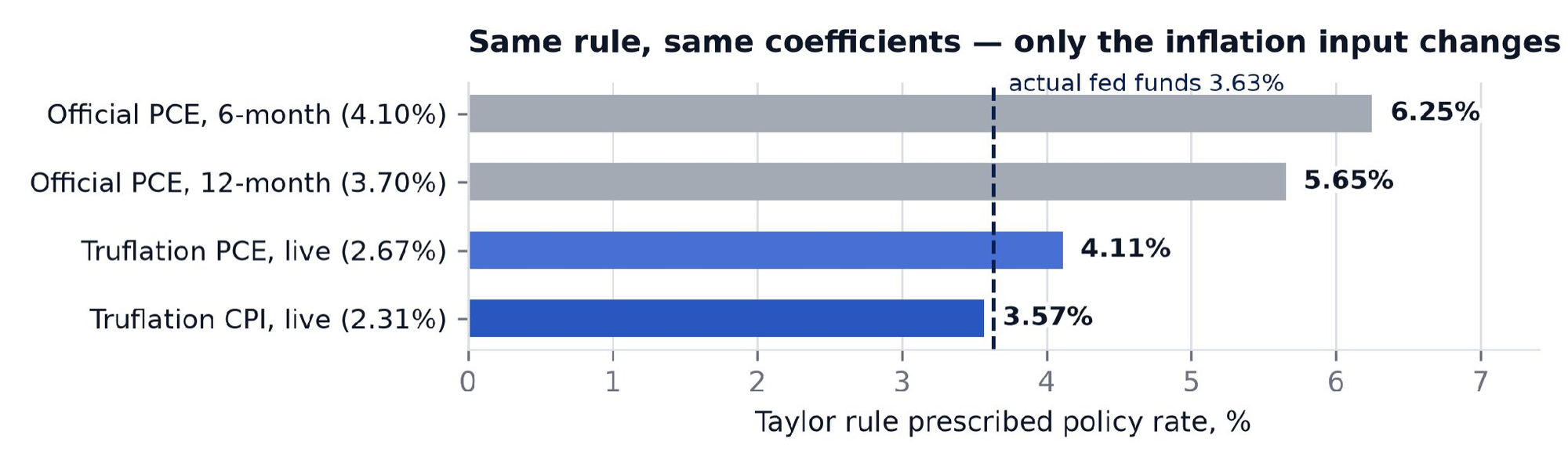
Same rule, same coefficients but a different 'vintage of truth'. Rules break because the inflation term averages a period that has already ended. Read that against the policy debate and the conclusion is uncomfortable: the entire disagreement about whether the Fed is behind or roughly right is a disagreement about measurement.
Illustrative calculation, not a forecast: r* = 1.0%, target 2.0%, 0.5 weight on the inflation gap, unemployment gap of u* 4.2% less u 4.1% at an Okun coefficient of 2.0; effective funds rate 3.63%.
Breadth beats headlines and breadth can be daily
The most operational part of the speech was methodological. Warsh disaggregates all 199 components of the PCE basket and watches how many are rising above 3%: 54% over the past year and 49% over six months, against roughly 32% in the two decades before the pandemic and a post-pandemic peak near 77%.
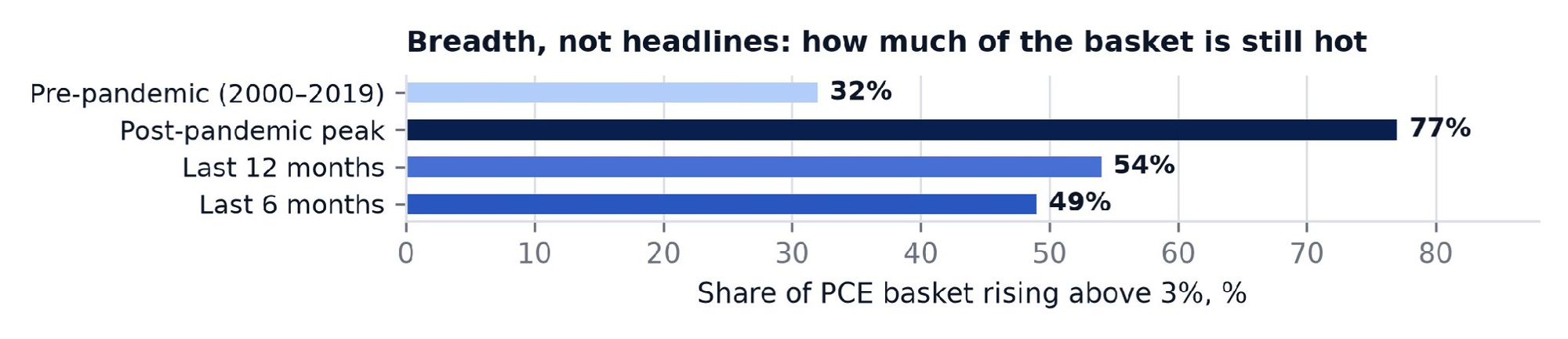
That is a trimmed-mean, breadth-of-inflation framework, and it is exactly what component-level architecture produces: daily, rather than monthly with a six-week lag.
The Fed is asking markets to do their own work
"Market participants themselves should be tracking real information across the economy… we should not indulge a regime in which market participants are looking primarily to the Fed for their next trade.
"This is the end of the hall of mirrors as a trading strategy, and the start of a market for independent macro evidence. If guidance is withdrawn, every desk, treasury and risk committee needs its own nowcast. That is a structural demand shift toward real-time, non-revising, auditable data.
There is a second-order consequence the Chairman did not spell out. If the Fed stops broadcasting its intentions, market-implied expectations stop being an echo of Fed guidance and start carrying real information again which makes the venues where those expectations are priced genuinely useful macro instruments. That is the thesis behind Truflation Predict: turning economic and financial data into live, tradable market outcomes, so an expectation is a price rather than a survey response.
A new factor of production with no price series
"AI is a new variable, potentially a new factor of production… we don't yet know the equilibrium price of the tokens."Tokens do not appear in the CPI basket. Warsh cited annualized token sales above $100 billion at the two leading labs, up more than 500% in a year, alongside equipment and intangibles investment growing around 9%.A monthly survey cannot measure a market whose unit price falls by orders of magnitude within a quarter.
Component-level, high-frequency measurement can: inference and compute costs by tier, energy and data-centre inputs, model-access pricing across frontier and legacy models, and the capex-to-output ratio of the firms doing the spending. Until those series exist, the Fed is being asked to judge a supply shock it cannot see, and every firm in the economy is repricing its cost base against numbers nobody publishes.
The nature of labour changes. The labour statistics do not.
Unemployment at 4.1% looks benign, and that is precisely the risk. The headline rate is a count of people. The AI and robotics transition is a story about the composition of tasks inside jobs, the wage attached to those tasks, and how quickly both reprice. A firm that redistributes forty percent of a role to an agent, keeps the person and re-grades the job creates no unemployment print while changing labour cost, labour share of output and productivity at once. The household survey is structurally blind to it.
Robotics extends the same problem into the physical economy. When capital can perform tasks that were previously non-tradable and non-automatable such as warehousing, inspection, last-mile logistics, elder care, the substitution is not marginal and it does not arrive as a layoff announcement. It arrives as a slow change in the unit cost of doing a physical task, which shows up in prices long before it shows up in employment statistics. This is exactly the sequence a monthly, revised, survey-based statistic is worst at catching.
So we measure the transition, not just the level: task-level exposure and displacement by sector, wage composition rather than average hourly earnings, labour share of output at firm and sector level, and the price of automated task execution; the robotics and agent equivalent of a token price.
Real-time data is the input. Truman is the interface.
Truman, our AI-powered analytics assistant, is the answer to the practical question the speech leaves open: if the Fed will not tell you what it thinks, who does your macro work? Ask Truman.
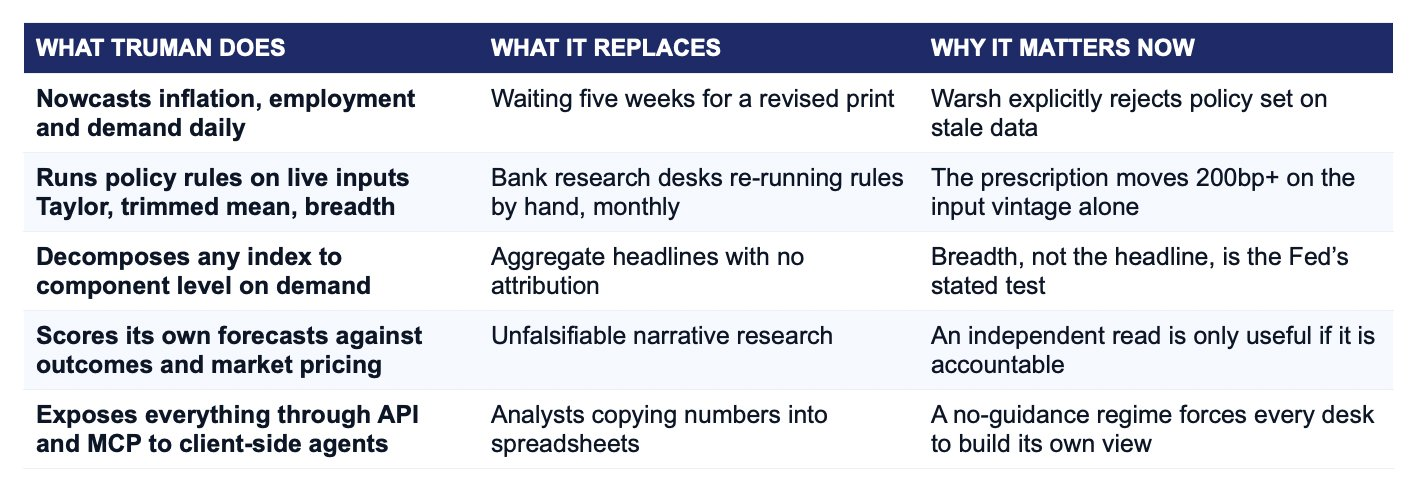
Four properties make it institutional rather than conversational:
It is deterministic: Analysis compiles into reproducible pipelines, so the same question asked twice returns the same method.
Every output carries data lineage: which index, which component, which vintage, retrieved when, so a risk committee can audit the chain from claim to source.
It scores itself against realized outcomes and market-implied forecasts, so its track record is a number rather than a claim.
It is composable paired by API or MCP with a client-side agent that holds positions, supplier costs and mandates, the same macro read becomes a hedge ratio, a repricing decision or a rate-path scenario without a human in the middle.
Warsh's standard has four words in it: relevant, contemporaneous, accurate, and actionable. The last one is not a data problem. Data becomes actionable when an agent can reason over it, cite it, and be graded on it.
The destination
Not a better inflation print. A trusted economic reference point for the global economy that is independent, transparent, and current enough that understanding economic change and acting on it become the same motion.The nature of labour will change before the labour data does. Anyone setting policy, pricing credit or planning headcount off a monthly survey is navigating a structural shift with a rear-view mirror. We would rather sell them a windscreen.The Chairman spent his first Jackson Hole asking for data that is relevant, contemporaneous, accurate and actionable.
We intend to be the place the market gets it.
Sources
- Kevin Warsh, "In Our Time," Jackson Hole, 28 August 2026 — https://www.federalreserve.gov/newsevents/speech/warsh20260828a.htm
- Truflation real-time indexes and official comparison prints, retrieved 29 August 2026 — https://truflation.com/
- Advisory Commission to Study the Consumer Price Index, "Toward a More Accurate Measure of the Cost of Living," report to the Senate Finance Committee, 4 December 1996 — https://www.ssa.gov/history/reports/boskinrpt.html