
The $70 Trillion Problem: Why Pension Funds Need Better Inflation Data

By Stefan Rust, CEO, Truflation
Market-based inflation expectations are rising across the curve. Polymarket currently prices a 100% probability of US inflation exceeding 3% in 2026, and economists at PIIE estimate a material risk of it surpassing 4% by year-end. Oil price increases, tariff pass-through, fiscal expansion, tighter labor supply, and drifting household expectations are converging into a macro environment that pension and annuity managers have not faced at this scale in decades.
This is not just a macro story. It is a data infrastructure story and the gap between how institutions measure inflation today and what they actually need is wider than most people realize.
The Structural Inflation Problem Facing Pension Funds
Pension and annuity funds face a fundamental inflation challenge. Persistent or unexpected inflation erodes the real value of pension liabilities and creates volatility when benefits are indexed to price levels. These funds hedge by exchanging fixed cashflows for inflation-linked cashflows via swaps and inflation-linked bonds, seeking to align assets with indexed liabilities.
But all of these hedges are priced off a single, lagged reference: government CPI, a monthly release built on survey methodology and static consumption weights that reflect the past, not the present. In a world where inflation is moving fast and unpredictably, a 30-day lag in your reference index is not just inconvenient. It is a structural source of basis risk.
How Inflation Swaps Work And Why the Reference Index Matters
An inflation swap is a derivative in which one counterparty pays a fixed rate and the other pays a floating rate tied to a realized inflation index. These instruments are the primary tool by which pension funds and insurers hedge inflation risk at scale. The two dominant structures are:
- Zero-Coupon Inflation Swaps (ZCIS): A single settlement at maturity based on cumulative inflation over the contract life, calculated as
- I_{T}/I_{0} - 1 , where I_{0} is the index level at inception and I_{T} is the index level at maturity.
- Year-on-Year (YoY) Swaps: Periodic payments based on realized 12-month inflation each period, providing regular hedge rebalancing.
The global OTC derivatives market stood at $846 trillion notional outstanding at June 2025, up nearly 16% year-on-year, with interest rate derivatives, the category that includes inflation swaps, comprising 78.7% of all outstanding notional. A February 2026 report from ISDA confirms that pension funds have steadily expanded use of inflation swaps, interest rate swaps, and currency forwards over recent decades as their primary risk management tools.
The reference index at the center of all these contracts is CPI. And CPI has not changed meaningfully in methodology or cadence in decades.
What Next-Generation Inflation Data Looks Like
Not all inflation indexes are created equal. When evaluating a reference index for institutional hedging or pricing purposes, the dimensions that matter most are:
Truflation's index draws on hundreds of millions of qualified, real-time data points from hundreds of verified providers and forecasts for the official government CPI releases within ±0.1 percentage points throughout 2024 and 2025 while leading with the official Truflation CPI by approximately 40–75 days. That lead time is the difference between reacting to inflation and anticipating it.
Four Ways Better Inflation Data Changes the Game for Institutions
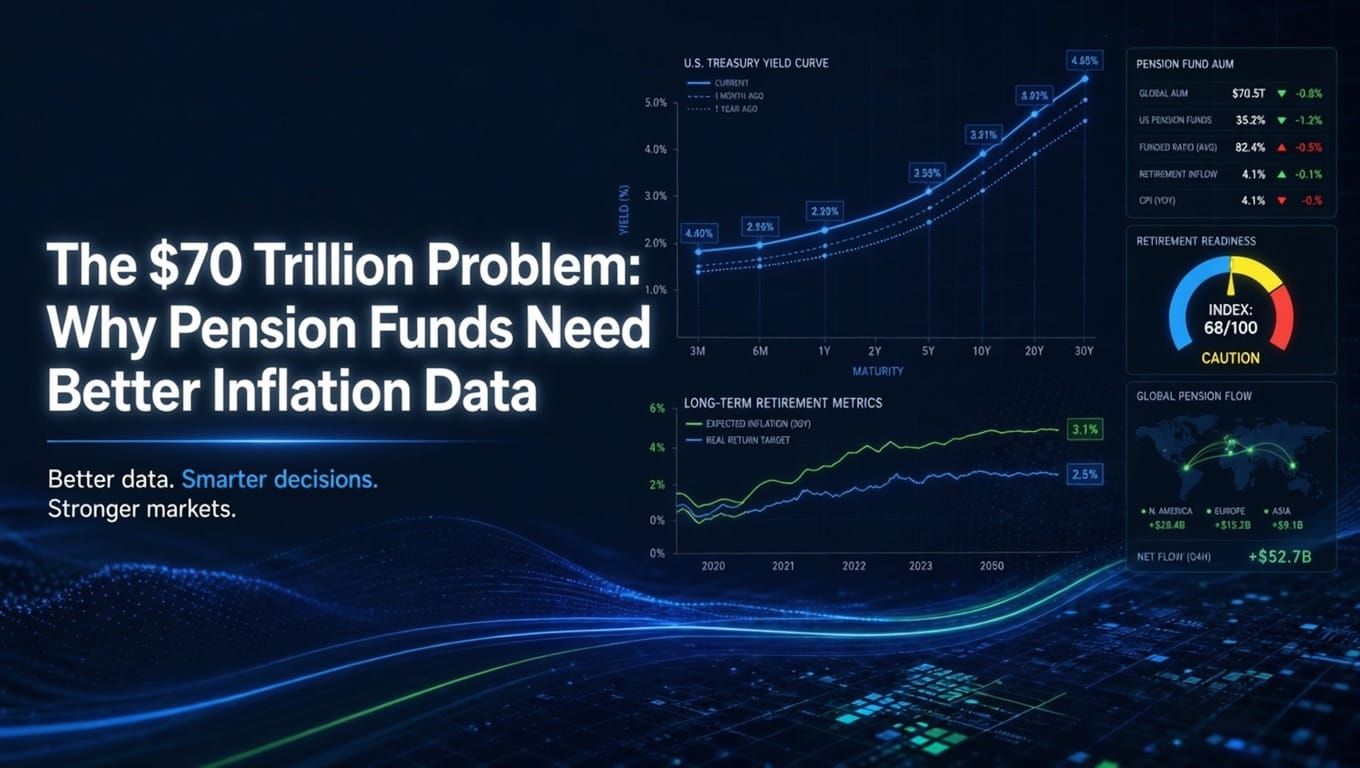
The pension fund universe is valued at approximately $71 trillion in 2026, growing at 5.6% CAGR toward $93 trillion by 2031. Inflation-linked annuities, products that tie payouts directly to realized inflation, represent the core product where basis risk between actual experienced inflation and the reference index directly costs funds and their beneficiaries money. More accurate, more timely data changes this equation in several concrete ways:
- Liability-Driven Investment (LDI) overlays. Real-time inflation data enables more dynamic hedge ratios that update daily rather than monthly, reducing the risk of being offside when CPI surprises.
- Annuity pricing. Insurers pricing inflation-linked products can use a real-time index as a more accurate cost-of-living reference, reducing adverse selection and improving reserve accuracy.
- Inflation swap settlement. A real-time, on-chain index can serve as the reference in bilateral or standardized swap contracts, replacing or complementing CPI for settlement purposes.
- Breakeven inflation signals. Real-time data gives traders and risk managers a forward-looking breakeven estimate they can act on before official releases, not after.
Why This Moment Matters
Three forces are converging to make this a critical inflection point:
Rising inflation uncertainty. US inflation is diverging upward from global trends, with prediction markets pricing 100% probability of above-3% outcomes. Demand for precision hedging tools is acute and growing.
Accelerating institutional derivatives adoption. Pension funds are increasingly using derivatives overlays as capital-efficient hedges. Euro area inflation-linked swap activity has surged, with hedge funds now representing approximately 50% of gross notional traded, up from under 20% in 2018. Institutions are not retreating from inflation derivatives; they are doubling down.
A new data transparency imperative. Post-2022, pension trustees and insurance regulators face increasing scrutiny on reference data quality. A blockchain-anchored, open-methodology index directly addresses audit and governance requirements that traditional CPI cannot satisfy.
The Infrastructure Layer the Market Is Missing
The inflation derivatives market is large, growing, and accelerating at precisely the moment when the quality of its reference data matters most. Pension funds and annuity managers deserve an inflation index that is real-time, independently verifiable, and built for the precision that modern risk management demands.
As the $70+ trillion pension fund market looks for more responsive inflation hedging tools, real-time data infrastructure becomes critical competitive infrastructure, not just for the funds, but for every platform, exchange, and protocol that serves them.
That infrastructure exists. The question is how quickly the market moves to adopt it.
Truflation provides independent, real-time economic and inflation data for institutional and on-chain applications. Learn more at truflation.com.
Download the Truflation paper