
Washington's "Inflation Lie" Has Cost America TRILLIONS in Debt – And Truflation Is the Fix They’re Too Scared to Adopt
Picture this: It’s 1996. Your grandparents are retiring. The government promises Social Security checks will keep pace with the rising cost of living. Fast-forward to today. The national debt is exploding past $39 trillion, annual deficits are routinely topping $1.5–2 trillion, and politicians scream about “unsustainable” spending.
But what if the entire crisis was built on a mathematical fiction?
What if the official inflation numbers we’ve been using for decades have been systematically overstated — pumping up entitlement spending, distorting wages, and quietly inflating the deficit like a balloon that’s now ready to pop?
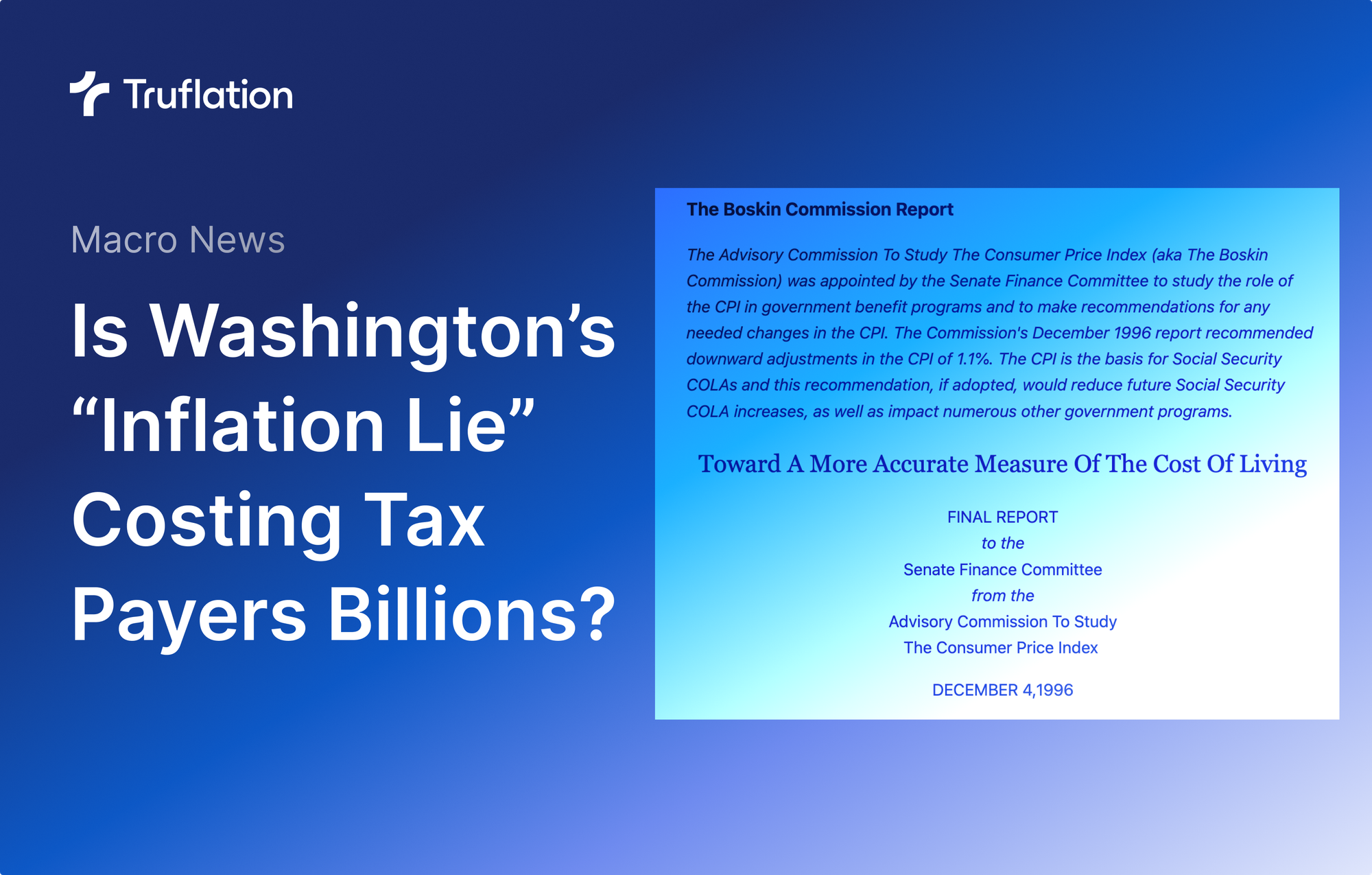
The Boskin Commission told us this exact disaster was coming. We ignored them. Now we’re paying the price.
The 1996 Bombshell Warning They Buried
In the mid-1990s, the bipartisan Advisory Commission to Study the Consumer Price Index — chaired by former White House economist Michael Boskin — dropped a report that should have changed everything. After rigorous analysis, they concluded the official CPI overstated inflation by 1.1 percentage points per year (plausible range: 0.8–1.6 points).
The culprits were crystal clear:
- Substitution bias (0.4 points) — people switch to cheaper alternatives when prices rise, but the fixed-basket CPI acts like we’re all stuck buying the same old stuff.
- Outlet substitution (0.1 points) — we shop at Walmart and Amazon instead of high-end stores, but the index barely notices.
- Quality change + new products (0.6 points) — your smartphone is infinitely better than the brick phone from 1995, yet the CPI often treats it like “same old gadget, slightly more expensive.”
Boskin didn’t just diagnose the problem. The Commission laid out the fiscal bloodbath ahead: correcting the bias would have trimmed projected federal outlays dramatically. CBO numbers showed the 1.1-point overstatement alone would add roughly $1.07 trillion to the national debt by 2008 compared to a corrected index. Social Security, Medicare, and other indexed programs would have grown far more slowly. Tax brackets would have adjusted more realistically. The deficit trajectory would have been completely different.
They didn’t stop at diagnosis. They explicitly called for a parallel, research-based CPI — one free from the BLS’s outdated Laspeyres fixed-weight straightjacket. A living, adaptable index grounded in science, real-time data, and continuous innovation. Because overhauling the official series was politically impossible.
Fast-Forward 30 Years: The Deficit Monster We Created
We didn’t build that second index.
Instead, we let the old CPI keep pumping extra cost-of-living adjustments into Social Security year after year. We let it understate real wage growth and productivity. We let it mislead monetary policy.
Result? Compounded over decades, that 1.1-point annual overstatement has supercharged mandatory spending while making deficits look like someone else’s problem. Every extra percentage point of “inflation” translates into billions more in automatic spending — and today’s politicians act shocked that the budget is out of control.
Meanwhile, the BLS is still largely stuck in 1980s methodology. Sure, they’ve made tweaks. But the core framework remains a legacy system that Boskin himself said needed a modern twin.
Enter Truflation: The Exact Index Boskin Demanded
Truflation did what the government wouldn’t: they built the parallel, science-first inflation index the Boskin Commission literally called for.
Using millions of real-time data points from dozens of sources, daily updates, dynamic weighting that actually reflects how households spend today, and modern techniques that capture substitution, quality improvements, and new products in real time — Truflation delivers a CPI that’s transparent, verifiable, and free from political baggage.
No more waiting months for stale government numbers. No more pretending a 1990s fixed basket represents 2026 reality. Just hard, unbiased data that shows what real inflation in real-time, answering to real market fluctuations.
And the fiscal upside is obvious. A more accurate measure would automatically slow the growth of indexed spending. It would give policymakers honest numbers instead of inflated ones. It would finally let us attack the deficit at its root instead of kicking the can down the road.
The Choice Is Obvious (And Politically Radioactive)
Washington loves big spending. Overstated inflation lets them do it on autopilot while pretending they’re just “protecting seniors” or “keeping pace with costs.”
But the American taxpayer is the one getting fleeced.
If we had adopted a Boskin-style accurate index decades ago, today’s deficit debates would look radically different. The debt wouldn’t be this monstrous. Real wages would look stronger. Investors would have better signals.
It’s not too late.
Adopt modern measures like Truflation. Use the parallel index Boskin demanded. Stop letting 30-year-old methodology dictate trillion-dollar fiscal policy.
The numbers don’t lie — even if the official CPI does.
America’s deficit isn’t just a spending problem. It’s a measurement problem.
And the solution is already built.
Time to use it.
What do you think — should we finally ditch the outdated CPI and go with real-time, science-based inflation data?
For more of real data for real markets subscribe to Truflation.