
What you need to know about the U.S. August PPI release

The BLS Producer Price Index (PPI) for August has accelerated again, with headline PPI rising 0.4% MoM and 5.4% YoY, reinforcing evidence that upstream inflationary pressures remain elevated.
However, the composition of the increase is important. The acceleration was driven by energy prices, which surged 4.2% MoM, contributing to a 1.1% increase in final-demand goods prices. In contrast, goods excluding food and energy increased a minor 0.1% MoM, while services also rose only 0.1%. This suggests that August's increase does not yet represent a broad based reacceleration in underlying producer inflation.
Nevertheless, the sharp increase in energy costs creates an important upside risk to the consumer inflation outlook. Higher oil and energy prices feed through into transportation, logistics, utilities and production costs and, if sustained, are likely to pass through progressively into the prices of both goods and services. The 2.3% MoM increase in transportation and warehousing prices is therefore particularly important to monitor as an early indication of this transmission mechanism.
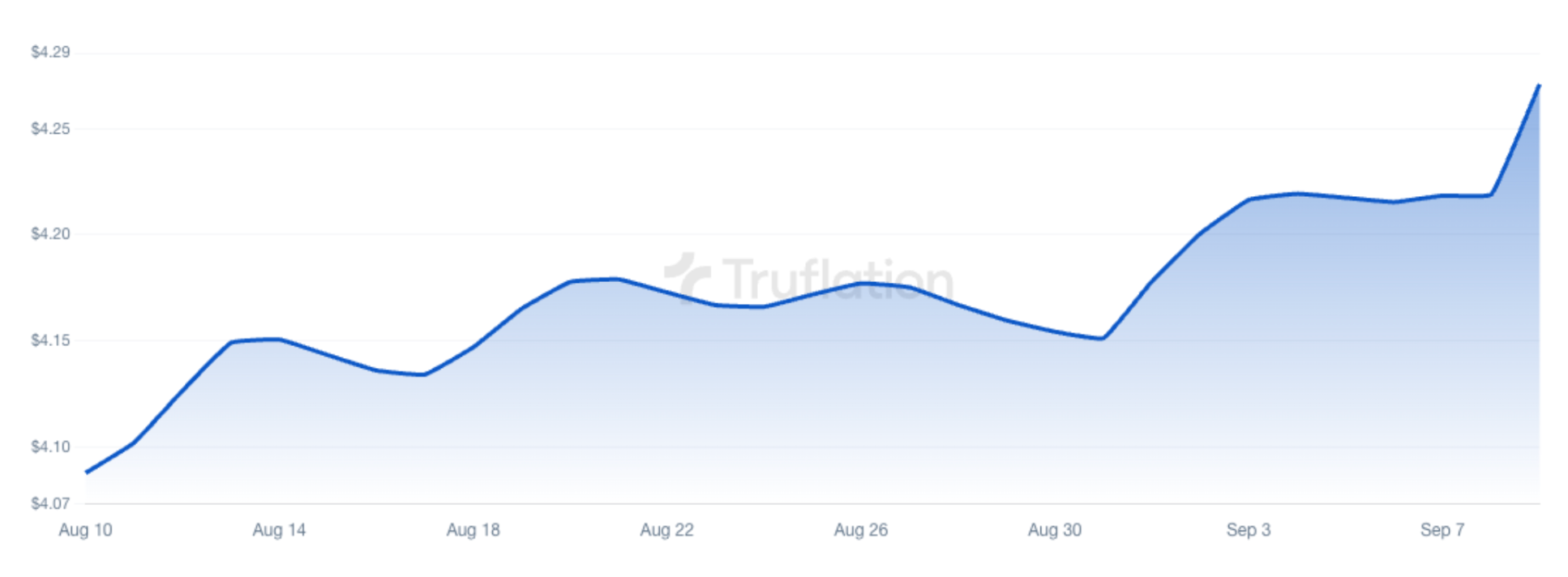
This risk has become more pronounced in September. WTI crude has risen from around $90 per barrel on September 1 to approximately $97 today, an increase of more than $7 per barrel. Brent crude has followed a similar trajectory and is now trading above $102 per barrel. The increase in crude prices has also translated into higher retail gasoline prices, as highlighted by the Truflation Gas Index, rising from $4.15 per gallon at the beginning of September to $4.27 currently.
If we strip out the direct impact of energy and focus on underlying goods and services prices, the picture remains considerably more muted. The PPI measure excluding food, energy and trade increased 0.3% MoM, while remaining at 4.7% YoY. This is still elevated and gives policymakers reason to remain cautious, but the concentration of August's acceleration in energy, alongside relatively subdued core goods and services prices, provides little evidence so far of a broad based resurgence in underlying producer inflation.
The key question for monetary policy is therefore whether the energy shock remains temporary or begins to propagate through the wider economy.