
The Frozen Labor Market: AI, Automation, and the Quiet Before the Storm

The U.S. labor market looks quiet from the outside. The Bureau of Labor Statistics reports 6.9 million job openings, layoffs little changed at 1.9 million, and quits holding at 3.2 million — all as of March 2026.
Recent Unemployment weekly reports looked technically positive, with the lowest Initial Jobless Claims in decades last week of April and lower-than-expected first week of May. Continuing claims also edged lower, and headline unemployment remained low.
It's the kind of numbers that lead to a reassuring "labor market remains resilient" headline and a quick scroll past. But economists have a more specific term for what's actually happening. It's called "low hire, low fire" — and it's been going on for more than a year. Hiring is suppressed. Firing is suppressed. Quit rates are suppressed. The economy isn't in a hiring boom or a recession spiral; it's in something more unusual: a freeze.
"We just have this stagnant labor market from a macro perspective, where companies aren't hiring many people, but they're also not choosing to lay off a lot of folks." — Laura Ullrich, Director of Economics, Federal Reserve Bank of Richmond.
That description captures the surface. What it doesn't capture is why — and what's being built underneath the calm.
Why are people getting laid off?
Four months into 2026, corporate America has filed nearly 1,600 layoff announcements affecting over 128,000 workers — roughly 5% fewer than the same period last year, according to WARN Act filings tracked by USA Today. On its face, that's marginally better news. But the composition has changed dramatically. The framing the companies use to justify cuts has shifted. Look at what companies said as recently as 2023 — cost-cutting, post-pandemic correction, macroeconomic uncertainty. Now look at May 2026:
Recent Layoffs Justifications:
- Coinbase cuts ~700 workers in an "AI-native restructuring."
- Freshworks eliminates 500 roles globally as part of "AI-led restructuring."
- Cognizant cuts ~4,000 jobs under "Project Leap" to boost AI capabilities.
- Pinterest lays off staff while "reallocating resources to AI-focused teams."
- Block (Jack Dorsey) cuts 40% of global workforce — ~4,000 employees.
AI is no longer a background justification — it's the official, named reason appearing in regulatory filings and press releases. That's a structural change in how corporate restructuring is being framed, and it matters.
Tech-specific data reinforces the pace: in 2025, the sector saw 674 layoffs per day, averaged across the year. In 2026, that's running at 961 per day. The absolute numbers aren't catastrophic. The acceleration is notable.
Is AI Actually Displacing Workers — or Just Taking Credit?
This is the honest question the data forces us to ask. There's a real risk that "AI restructuring" becomes the new "synergies" — a rhetorical justification for cuts driven by interest rates, tariff uncertainty, or the Iran oil shock rather than genuine automation. One VC investor said it plainly: many enterprises, regardless of how ready they are to actually deploy AI solutions, will cite AI to explain workforce reductions anyway.
But there are cases where it's clearly real. Salesforce CEO Marc Benioff confirmed on a podcast that the company reduced its customer support headcount from 9,000 to 5,000, directly attributable to agentic AI deployment. Klarna has publicly stated that its AI handles the equivalent of 700 customer service workers. UPS linked 20,000 job cuts to machine learning automation of logistics tasks.
Academic research is starting to confirm measurable effects. An MIT study from November 2025 estimated that ,using current AI capabilities — not future models, current ones. A Harvard Business School working paper on the labor market impact of generative AI found evidence of both displacement in automation-prone occupations and skill-transition pressure across white-collar roles.
The honest synthesis: AI displacement is real but uneven. It's hitting customer support, basic coding, content templating, data entry, and junior knowledge work first. It hasn't triggered a broad economic collapse. But the mechanism is active.
Are Businesses Waiting for Better Models?
One of the clearest signals in the current market is that enterprise AI adoption is running slightly ahead of enterprise AI confidence. Companies are restructuring around AI before they've fully deployed it, which raises the question of whether the real automation wave has even started yet.
Battery Ventures investor Jason Mendel articulated it directly at the start of 2026: "2026 will be the year of agents as software expands from making humans more productive to automating work itself." The framing — finally delivering on that value proposition — implies the expectation has been building, but the trigger hasn't fully fired.
The evidence for the "wait-and-see" mode shows up in hiring behavior more than in firing behavior. Rather than mass layoffs followed by mass AI deployments, the dominant corporate strategy appears to be attrition plus hiring freeze. Existing workers stay; vacancies go unfilled; AI takes on the incremental work. ServiceNow CEO Bill McDermott explicitly promised at Davos not to lay off employees as the company adopts agentic AI — but the company also isn't replacing every vacancy with a human hire.
"Many companies are silently closing the door to new ones. AI won't kill your job — it will kill the path to your first one." — Jeffrey Sonnenfeld, Yale School of Management (Fortune, April 2026).
This is the most structurally significant dynamic in today's labor market. The workers most at risk aren't the tenured employees at large companies. They're the people trying to get in the door — entry-level candidates, recent graduates, career changers. That pipeline is narrowing fast.
The Macro Complication: It's Not Just AI
Any analysis of the current freeze has to contend with the Iran-Hormuz conflict, which erupted in late February 2026 and has added a significant layer of uncertainty on top of the AI transition. Gas prices are up roughly 51% since the conflict started. Businesses that might have been building hiring plans are now recalibrating for energy cost pass-through and consumer demand softening.
The JOLTS data from March showed hires ticking up to 5.6 million — the first meaningful pickup after months of stagnation, according to labor economists who called it potential evidence the hiring recession may be ending. But that momentum now faces a direct headwind. Higher energy prices reduce household spending power, which reduces labor demand, which delays any rebound in hiring rates.
In short, the labor market was already frozen by AI uncertainty and economic caution. The oil shock has put additional weight on the ice.
Will Everyone Get Fired?
No. But that framing misses where the real risk sits.
The OECD's cross-country research on AI and employment found something counterintuitive: in occupations where computer use is high, greater AI exposure is actually correlated with higher employment growth. Workers who can leverage AI as a force multiplier tend to become more productive — and productivity growth typically supports employment rather than destroying it.
BCG's most recent analysis concludes that task automation doesn't equal job loss — most roles will remain but change substantially. That's cold comfort if you're a junior copywriter or an entry-level data analyst, but it describes a structural shift rather than an extinction event.
The distribution of impact is highly unequal. A survey of 1,000 U.S. business leaders found that high-salary employees without AI skills and recently hired entry-level workers face the highest layoff risk. The highest-salary roles are targeted for immediate payroll savings; the entry-level roles are simply not being backfilled. The people least at risk are workers who've integrated AI tooling into their workflows — who use AI as leverage rather than treating it as a threat.
Truflation Take
Truflation Take The "low hire, low fire" freeze is real, confirmed by BLS data, and has persisted for over a year. In our independent labor data, the situation looks even more bleak than the BLS data, with much lower job growth.
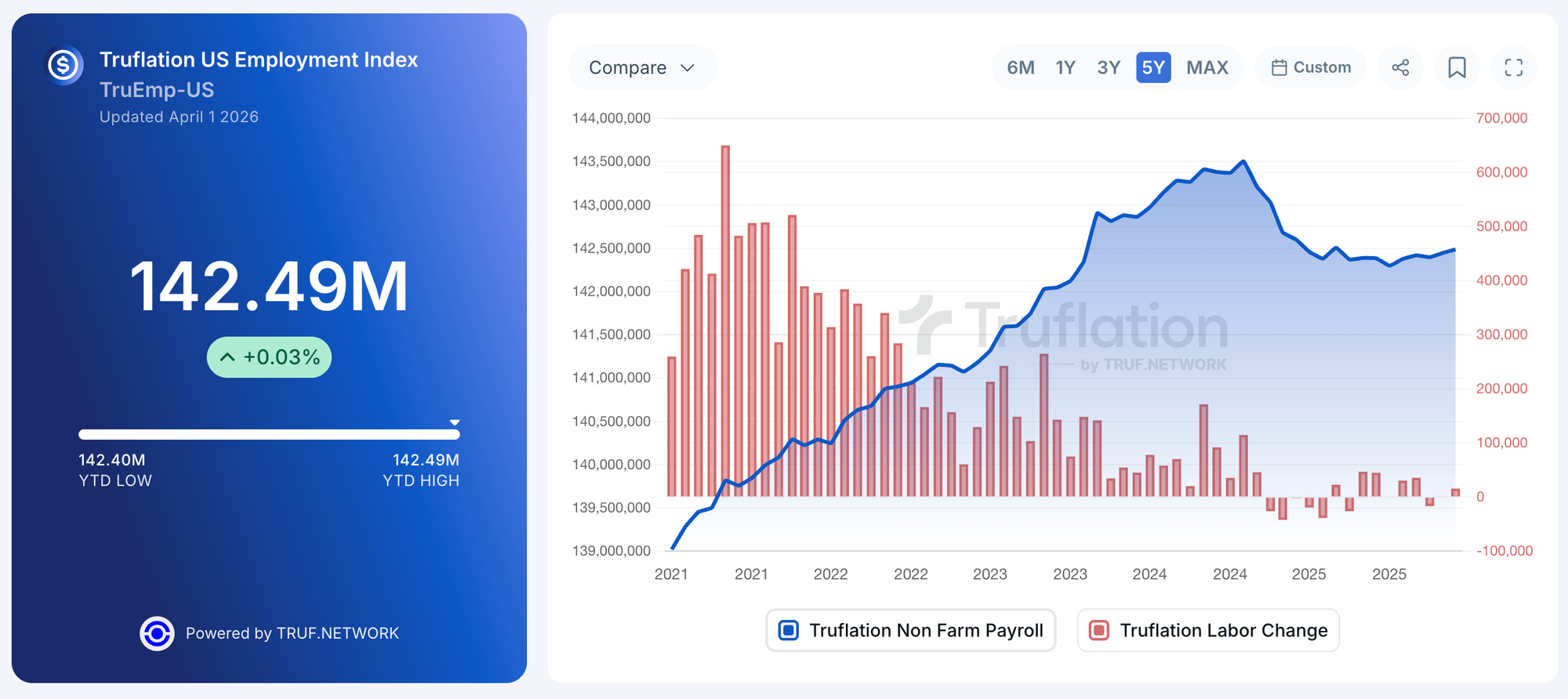
It's not stability — it's a market in transition holding its breath. The AI revolution in the workplace is genuinely underway, but in an early, uneven, strategic phase. Companies are restructuring around AI more than they're executing mass firing events.
The storm isn't fully here yet. But the architecture for it is being built quietly: hiring freezes, shrinking entry-level pipelines, AI-labeled restructurings accelerating in tech, and enterprise budgets shifting from labor to compute. The workers who should be most worried aren't necessarily the ones currently employed — it's those who haven't gotten in the door yet.
Watch the hiring rate, not the layoff rate. When the hires-to-openings ratio starts moving significantly, that will be the clearest leading indicator of which direction the ice breaks.